


No rings
NHS and HSE guidance: jewellery below the elbow is removed for clinical hand hygiene and around moving machinery.
NHS Infection Prevention and Control: bare below the elbows; HSE PUWER guidance on entanglement.
Active colours
Active & Flow colours
For site and trade
Non-conductive, no snag, rinses clean, and designed to stretch and tear away under a hard pull, which reduces the risk of ring injuries compared with metal.
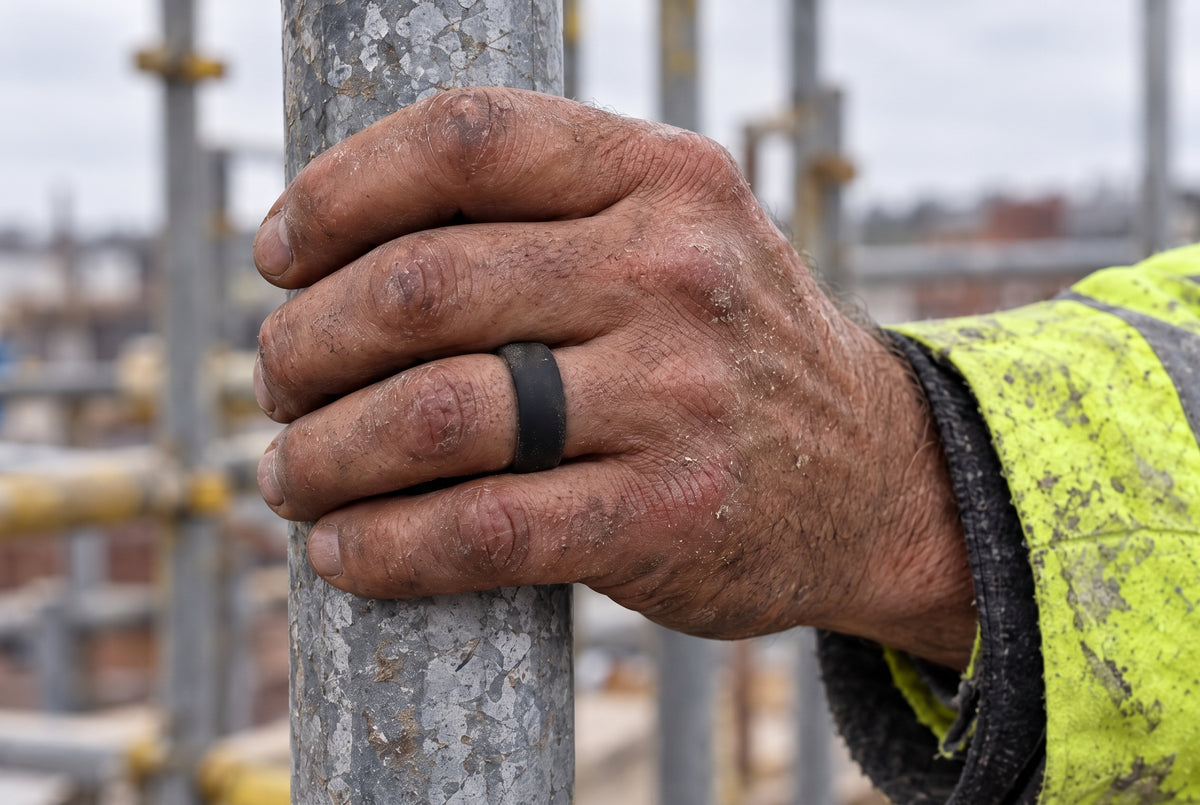
On site
Ask anyone who has worked on site for long enough and they will know someone who lost a ring, or worse, kept the ring and hurt the finger. A metal band near moving machinery, ladders, scaffold clips and vehicle doors is a liability. That is why so many trades simply do not wear one.
The injury is called ring avulsion, or degloving. A ring catches on something, the body keeps moving, and because the metal does not give, the finger takes the load. HSE guidance on working around machinery is clear that jewellery should be removed where there is a risk of entanglement, and most site inductions say the same. The problem is that a ring taken off goes in a pocket, then a van, then nowhere.
A silicone ring is designed to stretch and tear under a hard pull rather than hold the finger, which reduces the risk compared with a metal band. It is not a substitute for taking the ring off where your site rules require it, but it is a safer default on the days in between.
If you are an electrician, you know why a metal band is a problem around live terminals and battery banks. Silicone does not conduct electricity. It is not PPE and it does not replace insulated gloves, isolation and test-before-touch, but it takes one conductor off your hand.
Concrete dust, plaster, mud and brick dust rinse off with water. Silicone does not rust, pit or tarnish. Strong solvents and degreasers can dull the surface over time, so wash it with soap rather than wiping it with a solvent rag. It handles the everyday heat of a site, a van in July and hot water. It is not for welding, grinding sparks or open flame: take it off for those, as you would with any ring.
Measure the bare finger, not the gloved one. A silicone ring sits flat enough that it goes under a work glove without a lump. It should feel snug; if you are between sizes, go down. Hands swell on hot days and after a long shift, so measure at the end of the day rather than first thing. If it is wrong, swap it for another size within 30 days.
The double set is the one most trades go for: one ring for the working week, the other kept clean for weekends. Four-packs suit anyone who wants a spare in the van and a spare at home.

For site and trade
Non-conductive, no snag, and designed to tear away under a hard pull. Measure with the gloves off; buy the double so one lives in the van.
Evidence
Ring avulsion is rare but serious. A silicone band is designed to stretch and tear away under a hard pull, which reduces the risk of ring injuries compared with metal.
No rings
NHS and HSE guidance: jewellery below the elbow is removed for clinical hand hygiene and around moving machinery.
NHS Infection Prevention and Control: bare below the elbows; HSE PUWER guidance on entanglement.
General safety information, not medical advice.
Find your size
Calibrate the screen with any bank card, then drop a ring you own on it, or use a strip of paper. No ring? We'll predict it.
Step 1 · Calibrate. Hold a £1 coin on the screen and drag the handle until the circle matches it.
Not calibratedStep 2 · Place a ring that fits the right finger on the screen. Drag the handle until the circle sits exactly on the ring's inside edge.
No ring, no paper? We'll estimate from a few things about you. Expect ±1 size, and swaps are quick and easy.
| botthms | UK | Inside Ø | Circumference |
|---|---|---|---|
| 4 | H-I | 14.9 mm | 46.8 mm |
| 5 | J-K | 15.7 mm | 49.3 mm |
| 6 | L-M | 16.5 mm | 51.8 mm |
| 7 | N-O | 17.3 mm | 54.3 mm |
| 8 | P-Q | 18.2 mm | 57.2 mm |
| 9 | R-S | 18.95 mm | 59.5 mm |
| 10 | T-U | 19.8 mm | 62.2 mm |
| 11 | V-W | 20.6 mm | 64.7 mm |
| 12 | X-Y | 21.4 mm | 67.2 mm |
| 13 | Z | 22.2 mm | 69.7 mm |
| 14 | Z+2 | 23.0 mm | 72.3 mm |
Cookies
We use essential cookies to run the shop and basket. With your OK we also use analytics and marketing cookies to see what works and show relevant ads. Privacy policy
botthms help
Instant answers, real people too
